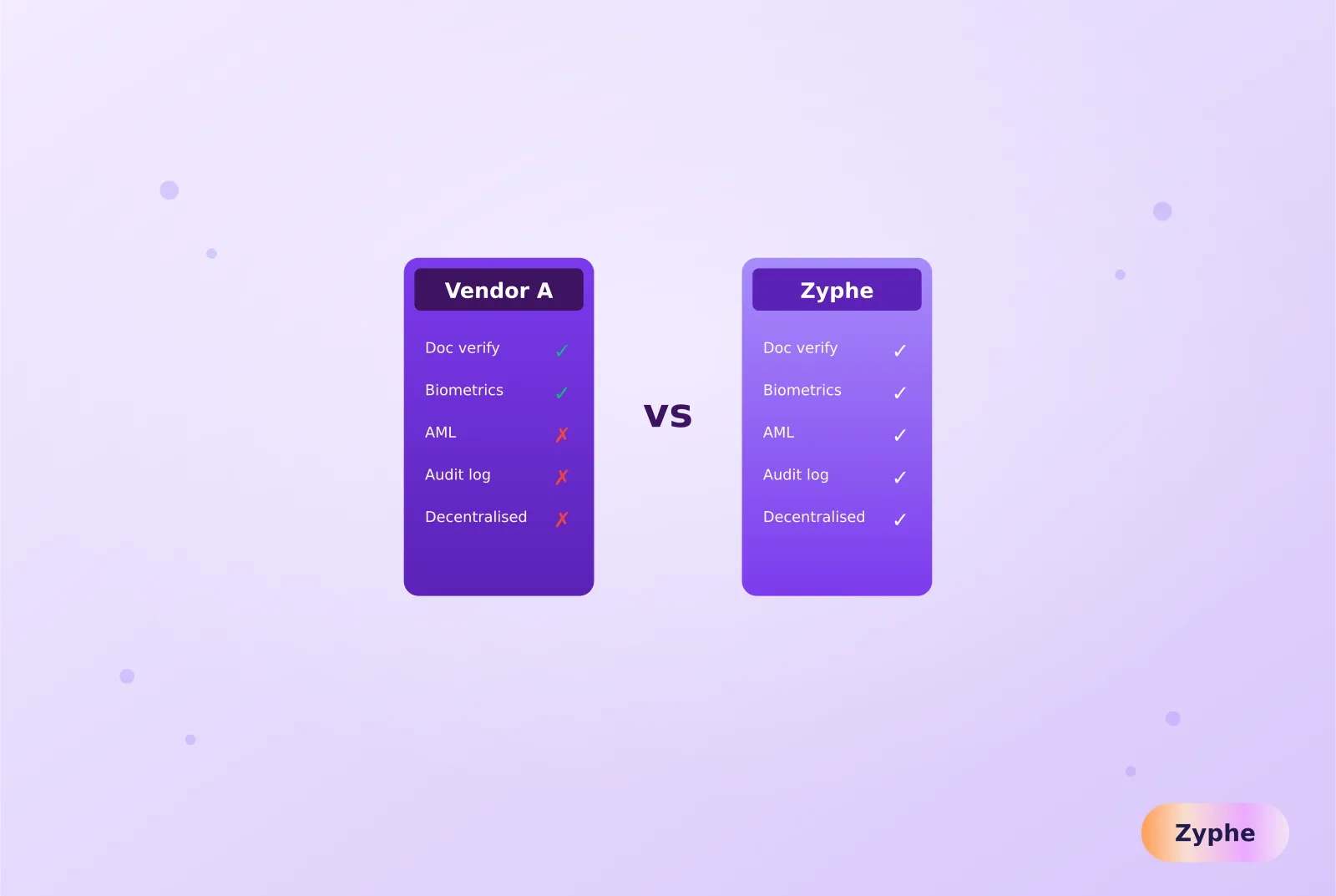
Compare 2026's top identity verification software, Jumio, Onfido, Persona, Sumsub, Veriff, Stripe Identity and Zyphe, on security, pricing and compliance.
Table of contents
Key highlights
- Identity verification software is roughly a $15 billion market in 2026, and the right platform for a crypto startup is rarely the right platform for an enterprise bank.
- The platforms that publish per-verification pricing (Stripe Identity, Sumsub, Veriff) suit usage-based buyers, while Jumio and Onfido, now part of Entrust, run sales-led enterprise contracts that often start in the tens of thousands per year.
- The differentiator buyers underweight is data architecture: most vendors store your customers' personal data in their own centralised cloud, which makes them a single breach target and a GDPR liability you inherit.
- Reusable credentials are the 2026 dividing line. A verification you can re-present without re-uploading documents cuts onboarding drop-off and removes the need to re-store raw identity data.
- Zyphe is built on decentralised storage across 60,000 nodes with a 29-of-100 threshold scheme, and the customer holds the encryption key, so there is no central honeypot for an attacker to take.
- Use the decision tree at the end to match a platform to your company type rather than to its G2 badge count.
Identity verification software confirms that a person is who they claim to be, using document authentication, biometric liveness, and database cross-referencing. In 2026 the category spans onboarding, fraud prevention, and compliance. The leading platforms differ most in where they store customer data, how fast they integrate, and whether a verified identity can be reused without re-collecting documents.
TL;DR
Identity verification software is a $15 billion market in 2026, and finding the right fit takes more than reading G2 reviews. The seven platforms most regulated firms shortlist, Jumio, Onfido (now Entrust), Persona, Sumsub, Veriff, Stripe Identity, and Zyphe, cluster into three buying patterns: developer-first usage-based tools, enterprise sales-led suites, and architecture-led platforms that change where identity data lives.
Most of these vendors do the core job well: read a document, run a liveness check, screen against watchlists, return a decision. They diverge on the things that bite you twelve months in. Centralised storage concentrates breach risk and GDPR exposure. Sales-led pricing locks early-stage teams into commitments they outgrow or under-use. And the absence of reusable credentials means every customer re-uploads documents at every firm, which is the single biggest driver of onboarding abandonment.
This guide defines the evaluation criteria upfront, profiles each platform with its real strengths and limitations, and gives you a decision tree by company type. Zyphe appears as one of the seven, and we are explicit about where it does not fit.
13 min read. Last updated 10 June 2026.
What is identity verification software, and what does it actually do?
Identity verification software answers one question for a regulated business: is this person real, and are they who they say they are? Under the hood, that breaks into a few jobs that every serious platform performs.
Document verification reads a passport, national ID, or driving licence and checks it for tampering, expiry, and known-template consistency. The stronger systems read the NFC chip inside the document rather than trusting a photo of it. Biometric liveness confirms a live human is present, not a printed photo, a screen replay, or a deepfake. Database and watchlist checks cross-reference the identity against sanctions lists, politically exposed person data, and adverse media. Decisioning then returns an approve, decline, or refer outcome that your onboarding flow can act on.
For decentralised KYC and modern compliance programmes, the software also has to do something it rarely advertises: store or discard the data it collects in a way that survives an audit and a breach. That storage decision is where the platforms genuinely differ, and it is the one most buyers skip past during the demo.
How should you evaluate identity verification software in 2026?
A demo shows you the happy path. An evaluation framework shows you the cost twelve months in. Six criteria separate the platforms that look alike on a feature grid.
Security architecture is first because it is the hardest to change later. Ask where customer personal data is stored, who can decrypt it, and what an attacker gets if they breach the vendor. A platform that holds all your verified identities in its own cloud is a concentrated target, and the breach becomes your regulatory problem, not just theirs. We cover why in why your KYC vendor is your biggest data breach risk.
Global coverage matters if you onboard internationally. Document template support, language coverage, and the ability to verify in opaque jurisdictions vary widely. Some vendors quietly fail on Gulf, African, or offshore documents.
API quality and integration time decide how long before you ship. Usage-based tools can integrate in hours; enterprise suites can take weeks of solutions engineering. See KYC API integration for what a fast integration looks like.
Pricing model determines who the platform is built for. Per-verification pricing with no minimum suits early stage. Annual enterprise contracts suit predictable high volume.
Compliance certifications and posture, including GDPR approach, data residency, ISO 27001, and SOC 2, tell you whether procurement will clear the vendor. Reusable credentials support is the 2026 differentiator: can a verified user re-present their identity without re-uploading documents, and does that remove the need for you to re-store raw data?
How do the seven platforms compare?
The table below scores each platform on the six criteria. Profiles follow, each with strengths, a real limitation, and the use case it fits best. We have kept the assessment evenhanded, because pretending a competitor is weak where it is strong helps no one make a good decision.
| Platform | Pricing model | Data storage architecture | GDPR / compliance approach | API integration time | Reusable credentials |
|---|---|---|---|---|---|
| Jumio | Sales-led, annual contract | Centralised vendor cloud | Mature certifications, vendor-held data | Weeks (enterprise) | No |
| Onfido (Entrust) | Sales-led, annual contract | Centralised vendor cloud | Mature certifications, vendor-held data | Weeks (enterprise) | No |
| Persona | Usage-based plus enterprise tiers | Centralised vendor cloud | Configurable retention, vendor-held data | Days | Limited |
| Sumsub | Per-verification, monthly minimum | Centralised vendor cloud | Broad coverage, vendor-held data | Days | Limited |
| Veriff | Per-verification | Centralised vendor cloud | Strong automation, vendor-held data | Days | No |
| Stripe Identity | Per-verification, no minimum | Centralised (Stripe) cloud | Inherits Stripe posture | Hours (Stripe stack) | No |
| Zyphe | Usage-based, no minimum | Decentralised, 60,000 nodes, customer-held key | Per-region residency, no vendor master key | Around 15 minutes | Yes |
Jumio
Jumio is one of the longest-established names in the category and a safe enterprise choice. Its document and biometric coverage is broad, its certifications are mature, and large regulated institutions trust it precisely because it has been audited many times over. The limitation is the enterprise posture itself: pricing is sales-led, contracts are annual and often start in the tens of thousands, and integration is a solutions-engineering project rather than a weekend. Best fit: large banks and enterprises with predictable high volume and a procurement process that expects a named account team.
Onfido (now Entrust)
Onfido was acquired by Entrust, with the deal completing in April 2024 (reported at around $650 million), and it now sits inside Entrust's broader identity-centric security portfolio. That gives buyers a wider product surface, from issuance to access management, under one vendor. Onfido's AI-led document and biometric verification remains strong, and its fraud research is widely cited. The trade-offs are the enterprise contract model and the integration work that comes with a large suite. Best fit: enterprises that want identity verification as part of a wider Entrust security stack rather than a standalone API.
Persona
Persona is the platform compliance teams reach for when they want to build verification flows themselves. Its modular, configurable workflows let a team assemble document scan, selfie, and watchlist steps without leaning on engineering for every change, which is a real advantage for teams that iterate on their funnel. Pricing runs higher per verification than the usage-based leaders, commonly cited in the $2 to $5 range depending on volume and configuration. Best fit: operations and compliance teams that want low-code control over complex, branching verification logic.
Sumsub
Sumsub has positioned itself as an all-in-one platform covering onboarding, monitoring, and case management, and it is popular in fintech, crypto, and iGaming. It publishes per-verification pricing, commonly cited around $1.35 to $1.50 with a monthly minimum near $149, which makes it accessible to scaling teams. The breadth is the strength and the watch-out: you are adopting a suite, and your customer data sits in Sumsub's cloud. Best fit: regulated, high-scale operations that want onboarding and monitoring from a single vendor.
Veriff
Veriff competes on speed and automation. It publishes per-verification pricing, supports a large document library, and markets a median decision in roughly six seconds with automation near 98 percent, which keeps abandonment low on the verification step itself. As with the other suites, verified data is held in Veriff's cloud, and reusable credentials are not part of the model. Best fit: consumer products where verification speed and pass rates are the priority metric.
Stripe Identity
Stripe Identity is the path of least resistance if you already run on Stripe. Pricing is transparent at around $1.50 per verification with no minimum, and integration inside the Stripe stack can take hours. The scope is deliberately narrower than the dedicated IDV suites, and data sits within Stripe's platform. Best fit: companies already on Stripe that need straightforward verification without adding a new vendor relationship.
Zyphe
Zyphe is the architecture-led option in this set. Instead of storing verified identities in a central cloud, it shards and distributes data across more than 60,000 decentralised nodes using a 29-of-100 threshold scheme, and the customer holds the encryption key, so Zyphe has no master key and there is no central honeypot to breach. Verification uses NFC chip reads from passports and ID cards (ICAO 9303 and eIDAS compatible) and a two-step biometric liveness check, with no user image upload, the system captures the photos itself. Reusable credentials let a verified user re-present their identity without re-uploading documents. The trade-off is honest: if your organisation specifically wants a long-established centralised incumbent with a decade of brand recognition in bank procurement, that is not what Zyphe is. Best fit: crypto, fintech, and privacy-sensitive firms that treat data architecture and GDPR exposure as first-order decisions. Manuel Tumiati, Zyphe's CTO and co-founder, has framed the design choice in customer conversations as moving the breach target off the table entirely rather than insuring against it.
How do you choose the right platform for your company type?
Use your company type, not a badge count, to narrow the field. The steps below get you to a two-vendor shortlist.
- Define your dominant constraint. Is it integration speed, breach and GDPR exposure, document coverage in hard jurisdictions, or procurement fit with an incumbent? Name the one that would actually lose you a deal or a customer.
- Match by company type. A crypto startup should prioritise fast usage-based integration and reusable credentials, which points to Zyphe or Sumsub. A neobank should weight data residency and ongoing monitoring, which points to Zyphe or Sumsub for architecture, or Jumio for incumbent procurement comfort. A marketplace optimising sign-up conversion should weight verification speed and pass rates, which points to Veriff or Stripe Identity. A large enterprise with a fixed procurement process should weight certifications and account support, which points to Jumio or Onfido (Entrust).
- Pressure-test storage. Ask each shortlisted vendor where customer data lives, who can decrypt it, and what an attacker obtains in a breach. The answers separate platforms that look identical on a feature grid.
- Run a paid pilot on real traffic. Measure completion rate, fraud catch, and time to integrate, not demo polish.
- Read the contract for exit terms. Usage-based with no minimum is reversible; a multi-year enterprise commitment is not.
What makes Zyphe's architecture different?
Every other platform in this comparison stores your verified identities in its own cloud. That is the model Zyphe was built to replace. Zyphe distributes each identity record across more than 60,000 nodes with a 29-of-100 threshold scheme, meaning no single node or location holds a usable copy, and the customer holds the encryption key. Because Zyphe has no master key, a breach of Zyphe yields fragments, not identities.
Coverage is built for regulated reality, not just the easy jurisdictions: more than 230 European corporate-registry databases, presence across 190 countries, recursive ultimate beneficial owner tracing down to 0.001 percent ownership, and specialist handling for opaque jurisdictions such as the BVI, Cayman, and the Marshall Islands. Data residency is enforced per region, so Swiss data stays in Switzerland, Singapore data stays in Singapore, and EU data stays within EU member states. Screening runs against World-Check, ComplyAdvantage-equivalent feeds, OFAC, the EU consolidated list, UK OFSI, UN, and government-direct lists.
The reusable-credential model is what connects architecture to conversion. Because a verified identity can be re-presented without re-uploading documents, you remove the re-verification step that drives onboarding drop-off, and you remove the need to re-store raw identity data on your own systems. If you are weighing build-versus-buy at an early stage, the companion guide on KYC for fintech startups covers the same trade-offs from a founder's seat.
What does identity verification software cost in 2026?
Pricing splits cleanly into two models. Usage-based vendors publish a per-verification rate: Stripe Identity around $1.50 with no minimum, Sumsub around $1.35 to $1.50 with a monthly minimum near $149, Persona commonly $2 to $5 depending on configuration, and Veriff per verification on published rates. Enterprise vendors, including Jumio and Onfido, are sales-led, with annual contracts that industry buyers commonly report starting in the $50,000 to $200,000 range.
The headline rate is not the real cost. The real cost includes integration time, the price of onboarding abandonment when users have to re-upload documents, and the contingent liability of storing raw identity data you could have avoided holding. For a full model of where compliance spend actually goes, see the real cost of KYC compliance. Zyphe prices on usage with no minimum commitment, and the reusable-credential model is designed to reduce the abandonment cost that never shows up on a per-verification quote.
When should you not switch identity verification vendors?
Switching is not always the right move, and an honest buyer's guide should say so. If your current platform clears procurement, passes your audits, and your onboarding completion and fraud numbers are healthy, the migration cost may outweigh the gain. Re-integrating verification, re-papering data processing agreements, and re-training your operations team is real work.
There are also cases where a centralised incumbent is the rational choice. If your buyers are large institutions whose procurement teams specifically require a named, long-established vendor with a decade of bank references, that requirement can outrank architecture on paper. And if your volume is low and stable, the marginal benefit of usage-based pricing is small.
The case for switching is strongest when one of three things is true: you are accumulating raw identity data you do not want to be holding when the next breach headline lands, your onboarding abandonment is driven by document re-uploads, or you are locked into a contract that no longer matches your volume. If none of those apply, stay put and revisit in a year.
The bottom line
Identity verification software in 2026 is not won on document-reading accuracy, which most serious platforms have largely solved. It is won on the decisions you feel twelve months in: where your customers' data lives, whether you are accumulating a breach liability, how fast you shipped, and whether your users abandon at the document-upload step. The seven platforms here are all credible. They are built for different buyers.
Match the platform to your dominant constraint and your company type, pressure-test the storage answer, and run a paid pilot before you sign. If reducing data-storage liability and onboarding abandonment is your constraint, the architecture-led approach is worth a serious look.
See how Zyphe compares, book a personalised demo or read how it works.
Related resources
- What is decentralised KYC, and how does it work?
- Why your KYC vendor is your biggest data breach risk
- KYC API integration: adding identity verification to your stack
- AML compliance software in 2026: what to look for
- KYC for fintech startups: compliance from day one
- The real cost of KYC compliance
- Perpetual KYC: from photograph to video
Cited sources
- Entrust, "Entrust Completes Acquisition of Onfido," April 2024: entrust.com
- TechCrunch, "Entrust is buying AI-based ID verification startup Onfido," February 2024: techcrunch.com
- Mordor Intelligence, "Identity Verification Market Size, Growth, Trends": mordorintelligence.com
- EU GDPR information portal: gdpr-info.eu
- European Commission, eIDAS / EU Digital Identity: digital-strategy.ec.europa.eu
 Michelangelo Frigo(Co-Founder at Zyphe)Michelangelo Frigo is a privacy and identity infrastructure expert and co-founder of Zyphe.